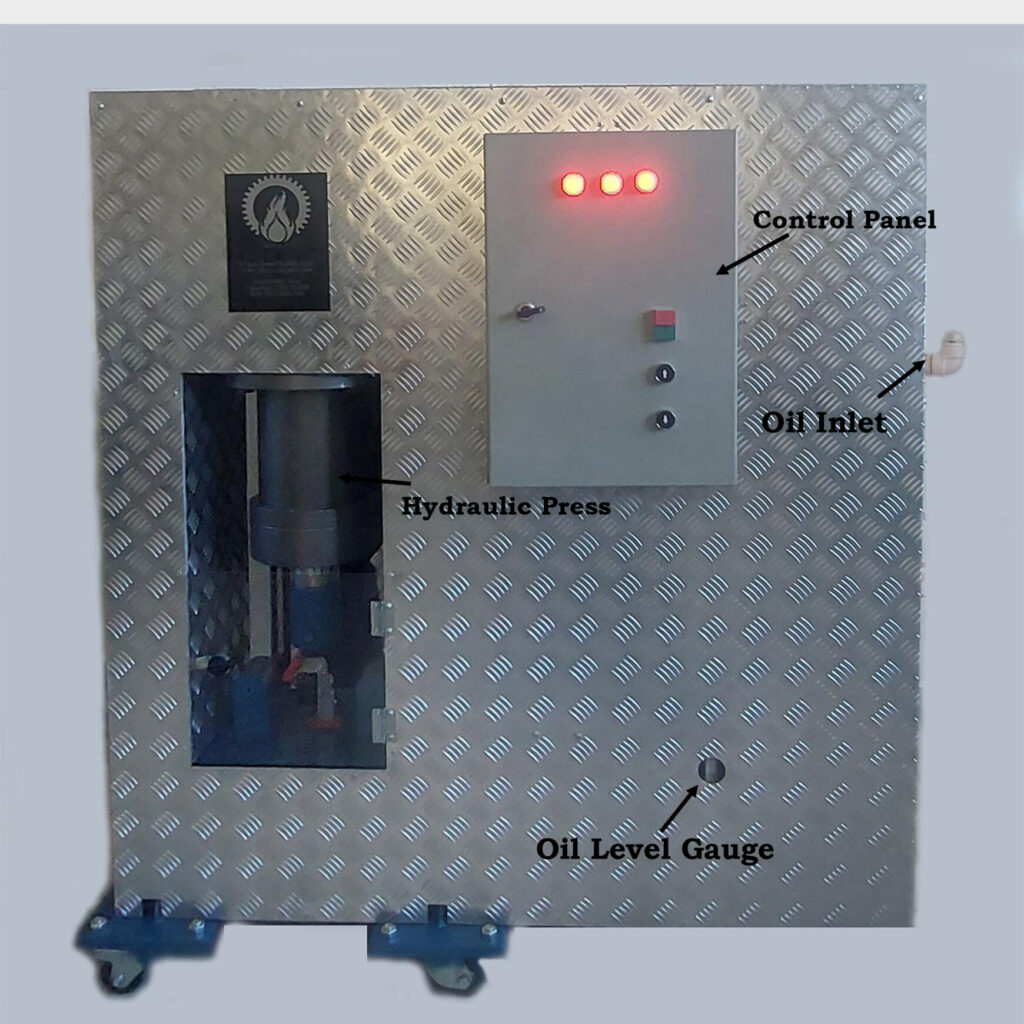
The flexibility test is designed to check the resistance of three-layer polyolefin coatings applied on metal to bending at different angles. This test is performed on cut pipe samples. This device is designed in accordance with ISO 21809-1 (2014) and ISO 21809-2 (2014) standards, and it has the possibility of examining samples at different bending angles.
Device components:
The flexibility testing machine has a hydraulic system to apply force, a base and mandrel system to apply bending, and a digital protractor to observe the degree of bending of the sample.
Test sample:
Coated laboratory samples should be cut to dimensions of at least 200 mm in length and about 25 mm in width along the axis of the pipe, or a coated laboratory sample with dimensions of 6.4 x 25 mm and a length of at least 200 mm should be used.
Why is this test important?
Pipeline coatings must bend and move with the steel during transport, installation and service without cracking or losing adhesion. If a coating is too brittle, cracks can open and water and soil chemicals can reach the steel. The flexibility test shows, in the laboratory, how the coating behaves when the pipe sample is bent to a chosen angle. It is useful for coating manufacturers, pipe coating plants and quality control laboratories.
How the test is done:
- Cut the coated pipe sample to the required size.
- Place the sample on the base of the machine.
- Apply force with the hydraulic system so the sample bends around the mandrel.
- Read the bending angle on the digital protractor.
- Examine the coating at the bend for cracks or other damage.
Ordering information:
This flexibility testing machine is made by Mirab Sanat Co. For a price quotation, delivery time or more technical details, please contact us.
Why coating flexibility is tested
Coated pipes are bent in the field to follow the route of the pipeline, and the coating must stretch with the steel without cracking or losing adhesion. In the flexibility (bend) test, a strip cut from a coated pipe is bent over a mandrel to a specified angle per pipe diameter length, often at a low temperature, and the outer surface of the coating is then examined for cracks. The test checks both the coating material and the quality of the application.
Flexibility testing is part of the qualification and production testing of FBE and three-layer polyolefin coatings, together with the impact, cathodic disbonding and indentation tests.
Frequently Asked Questions
Which standards specify the flexibility test?
Why is the test done at low temperature?
How is the bend angle measured?